Thursday, 3 December 2015

A New Dawn is Upon Us: How Services are being "revamped" in the DTES

Shortly after 12:00pm, on Friday, September 18, a woman pushed her way out the front entrance of her building in Vancouver, and collapsed in the street; she died shortly after of fatal stab wounds. The local media didn’t say much about this, except that the stabbing happened at a residential building in the Downtown East Side; that the victim had been in an altercation with her neighbour; that the assailant would be charged with second degree murder; and that this was the twelfth homicide in Vancouver for 2015. 

The official news reports leave a lot to the imagination, and readers will likely pass over the incident as a drug-induced quarrel between two "crackheads," criminals, or the mentally insane—whatever is commonly understood as a typical resident of the infamous DTES. The few comments left by readers are telling, but sadly not surprising, for they evoke what is becoming a common view: that tax money is being wasted on the concentration of social services in the area; that crime is rising in the city and that solutions need to be found; and that the partial remedy is to clean up those 10 square blocks of an area often referred to as the poorest—though rapidly gentrifying— postal code in Canada. But what are we missing if we buy into this narrow perspective? A crisis of care in this country that has been going on for far too long. 

The fact is that both of the people involved in this stabbing are victims: they are two of the many casualties of a system of neglect otherwise known as “community mental health care.” I am referring to the ad hoc patchwork of sub-contracted agencies, that cropped up in the 1970s and have really proliferated since the 1990s when de-institutionalisation was ramped up with little foresight. These agencies have come to be stand-ins for delivering the services and supports that were formally under provincial and federal umbrellas. And the implications for public health—and human rights—have been devastating. Unfortunately, we take the government’s hands-off approach for granted; and service providers are in a double bind. 

And the purse strings are tightening again with many services getting cut, which is perhaps why no one from the community has spoken out about this double tragedy. We are all too afraid of losing our funding: so we turn a blind eye, choke down our collective sadness, and do what we can to conceal the fact that premature death—either slow and miserable, or increasingly brutal and violent—is the actual result of a mental health care system being undermined by socially irresponsible governance.

I knew both of the people involved in the stabbing. I am a mental health worker in the DTES’s only mental health drop-in, a place where both regularly spent time during the day — though less frequently as of late. As far as I can tell they were barely acquaintances, though they did both live at the same supportive housing, a building knowns as the end zone for people considered “unhouseable.” Quite a few of the people I see on a daily basis live there; people with mental illness and addictions issues, as well as autism and dementia. The workers there are dedicated bunch; but like all of us in the field, they are in over their heads.

The drop-in opened in the early 90s, to provide a safe space for those who were literally dumped onto the street when most of Riverview Hospital was closed like so many other psychiatric hospitals in the “developed” world. Some of my more senior co-workers were there when the white vans pulled up, and some of the people who were dropped off in the DTES are still around. Their issues are far more complex now though: many have fallen prey to the local drug industry as well as to the slumlords all too happy to cash in on people with very few options. The fact that some of these people are still alive—though we have a wall of pictures of the prematurely dead—is a testament to their resiliency, not to the quality care in a country that falsely prides itself on having an equitable health care system. 

The drop-in is important because it is place where people can access not only food, clothing and advocacy services, but also a few leisure opportunities. But it seems that fun is even less of a right for the mentally ill than adequate food, housing, and care in this country. Leisure is increasingly unpopular among funders, despite the benefits of art and recreation which studies show

The drop-in is also important because  over the decades  an invaluable (and unquantifiable) sense of community has been forged there against the odds: a community of proximity, of suffering and of survival. But sadly this sense of community is being eroded. Because the drop-in is also a space that makes one intimately acquainted with the illogical, frustrating, inhumane, effects of ever-evolving policies and glossy strategic plans that reflect a deeper respect for the bottom line than for the people we serve. The deficiencies of this system play out in more and more of our interactions and as workers we are forced to inflict surrogate violence on this community. 

We clothe and feed people with donations; in other words, what is no longer usable or saleable; and increasingly, questionable corporations are handing things out and funding token projects: this gets them tax credits and kudos for social responsibility—the government welcomes the public/private partnerships and rewards those who promote them, often at the cost of  peoples’ dignity. We hand out crack kits, meth pipes and syringes because “harm-reduction” is what gets funded these days—yes it saves lives, but nobody questions the quality of these lives and we’re doing harm reduction until we’re blue in the face; We also get people on wait-lists for the detox-treatment-homeless-again merry-go-round and there is nothing more frustrating than that sense of futility and contradiction; except maybe making calls to homeless shelters with revolving doors; or trying to advocate for people to get a 10 by 6 rooms in buildings that are virtual warehouses for “problem people”; To be fair, some aren’t too-infested with cockroaches, rats and bed bugs, have a working washroom on each floor and a couple of over-worked resource workers on site—those are on the better side of the human storage continuum.More times than I care to remember though, I have had to tell someone that their only option for now is the street —and sometimes that is the better option. We’re still waiting for the government’s national housing strategy by the way—in the meantime we’ll just keep telling people to be patient. 

When we notice that one of our regulars is really not doing well, we call the Community Mental Health Team, which consists of a handful of dedicated psychiatrists, psyche nurses, social workers and mental health workers, whose caseload is well over 1400—translating into over 125 visits a day. There is also the ACT team now: Acute Community Treatment—which is composed of small pods of similar workers, and these meet clients out of office. But again, these teams of mobile professionals are few, and have an ever growing caseload. So our best bet is the police, who can apprehend people under the Mental Health Act—which is often our only recourse when someone is so mentally unwell that they don’t sleep or feed themselves; or have become so anaemic that they’ve collapsed, or when we know they are very likely going to get beat up—or maybe killed—because of their erratic behaviour (or shot by the police, which happened 3 times in the greater-Vancouver area in 2014, though I doubt that was included in the homicide stats.9). 

So the best solution for day-to-day management of mental illness is the default to medicalization. And often this is in the form of a prescribed and mandatory injection (monthly, or bi-monthly), the main purview of the mental health team: it’s efficient, and cost effective and If someone misses their appointment, they will be sought out. Non-compliance means apprehension by the police, involving what comes very close to a SWAT team. This sends quite the message to the community: that they best behave, and that they have no rights. 

The person is generally removed with little fight, and a fear in their eyes that is indescribable. The process is quite traumatic for everyone involved including the workers who had to make that call and get to feel complicit. Usually the apprehended are taken to the psych ward at St. Paul’s hospital (where there is a total of 69 psychiatric beds, and last year there were 7345 mental health related visits). After a short stint there they are usually released to their “community”—back to the poverty and instability of their day to day lives

This is community care, and it has not fulfilled its promise of providing more humane mental health care or any semblance of quality of life. The rhetoric merely masked the real priority of cutting back on expenditures— but at what cost? Emergency rooms are full, the police only show up 1 out of 3 calls, while the prisons are filling with people with mental illness who face solitary confinement. Meanwhile we have experienced continued program cuts, little commitment from federal and provincial governments to improve a historically deficient mental health system, and the constant undermining of some of the more valuable services that have managed despite the odds. 

Vancouver Coastal Health—one of the main bodies that allocates government funds in Vancouver— has recently introduced its “Second Generation” report, ostensibly in response to the deficiencies I have described. Their plan speaks of collaboration, a more comprehensive system of community care, with services that are more health-related and accessible to clients, and with more "peer support" to remove barriers—lofty intentions that sound very familiar, which is why we should be scared for those whose lives are always at the whims of expertise.   

At the dawn of this new generation, the DTES mental health team is facing cuts. The Network, got slashed after 20 years of doing real peer-based support. Gallery Gachet a therapeutic, peer-cased art collective for mental health survivors has lost it's funding too—this was announced the week of the stabbing and I don’t think it’s a stretch to make a symbolic connection between the two. At the same time, invaluable advocates, those that dare speak out for the mentally ill, are being laid off from some of the only programs specifically for people with mental health issues: first the Kettle society and MPA, now perhaps the drop in, where we have been told that we must now compete for funding with 5 other services, some that have addiction as their mandate. 

If we “win” the funding, they will close, and our focus will likely no longer be mental health but addictions, to make up for this loss. While the two are very much related now, thanks in large part to policies dolled out with little foresight—they should not always be conflated. But we have no choice but to try and sell ourselves, focusing on raising narrowly defined health statistics which do not really measure quality of life; and focusing more on putting clients back in the workforce—as if everyone is fit to work—with "peer support” now implicating cuts to trained staff. We are running with fewer workers, longer hours and a growing clientele—which puts us all at risk. Our advocacy services are being faded out. Our recreational programming is being gutted. But “if the funder wants fruit salad, we will give them fruit salad,” so we’ve been told by the consultant hired to make us more efficient. 

Competition is the opposite of collaboration, and reflects how the values of business-minded governments continue to penetrate the realm of human care.  Not surprisingly, there is a move within non-profits in Greater Vancouver to amalgamate and expand to gain leverage over others. With this comes the tendency to organize around a corporate structure and value system that undermines community ideals and alienates the people who rely on our support. And as workers, forced to compete within the bind of public/private partnerships now, we have become afraid: to speak out within our organisation, afraid to speak out for the casualties of this system—or risk losing our jobs. We have little say now in how our organisation is run, and even less say about the government policies which dictate its social mandate. We can’t risk offending the wrong people, because then our clients will suffer the fallout. 

And where would people go to get away from the street or their 10 by 6 dwellings if places like the drop-in close? What will become of their lives if our sole purpose as service providers is to feed, and clothes poorly, and medicate blindly? What happens to people who have been coming to our centre for over 20 years, to people like the  woman who was stabbed, and her assailant who found his way to one of our last remaining institutions. Of course the onus is on us lowly workers, while the government is off the hook again. 


Tuesday, 11 March 2014

Self Care Tips To Survive a Careless World

I've been going through a little bit of a rough time. It seems all sorts of stress has finally caught up with me in the last month for here I lie with the flu for the second time in weeks, which is getting a little bit depressing not to mention a bit freaked out (I am a bit of a worrier!) for I am generally the type of person who bounces back from a cold in less than a day: I eat better than average, get plenty of rest, and ride my bike at least five days a week. But I do take on stress, its true, and for the last year have not coped as healthfully as I know I could. I have sneaked more cigarettes than usual probably wreaking havoc on my body's defences, I have spent a bit more time zoning out on the computer than I have being mindful, and I have indulged more in gossip and bitching lately--all symptomatic of the cycle of stress and anxiety that feeds on such behaviours which are themselves fuelled by small (though always ballooning!) changes in life (and not just mine, I have a tendency to take on the weight of the world when I am in a susceptible state like the one I am in now). So I need to reboot and remember the healthy little things that keep me glowing and grounded and that force the bugs to stay away. To fight the blues of being sick and focus on the health, mental and physical, that I have taken for granted this last while I have compiled these tips for living mindfully that I look forward to indulging in each day from now on once I regain what truly is a gift. 

Things That Ground: 

-Cycle, walk, or swim each day--particularly on workdays to segue out of your public and into your private reality.

-Write (or express yourself the way you need to express yourself artistically) everyday. Or at least most days, especially when you are feeling out of touch with yourself in order to pay attention to your inner monologue so that you can be in touch with yourself again.

-Spend quality time with yourself as much as you can. If your social/work/family life is too crazy for you to be able to spend alone time each day, consider taking yourself out (or keeping yourself in!) once a week--or better yet take yourself out for a small holiday! Also, consider using your lunch break as "me" time. Go for a walk, go people watching, go write...

-Eat delicious, home made, and grounding foods at every meal and take the time to savour each bite. I'm good at doing the first part but tend not to often honour the beautiful meal I have prepared, which is in many ways worse than eating out for each meal because it means I am not recognizing my own creative capacity and implicit efforts to self care. Take the time (if you can) to cook a delectable simple meal (even if its just for yourself), to sit with it, and at lunch to heat your food if it is meant to be eaten warm and do not eat it out of a plastic container. I often forget to breath, especially while I am eating--that could potentially be deadly.

-Have a morning ritual and get up earlier to be able to enjoy every step. I feel much better if I can drink lemon water first thing in the morning, stretch, and then have a delicious breakfast. If I skip one step I feel off kilter for the rest of the day. I have been feeling like a train wreck lately and that is no coincidence.

-Spend time with animals!

-Spend time with your family--especially ageing family for they are our link to the past and feeling connected to history and to our loved ones is one of the most grounding things in this fragmented crazy world that tends to erase our collective memory with each new gigabyte of information we are given access to. If you aren't close to elders in your family, adopt some!

-Nurture your own memories. I have recently purchased some of the books I like best as a child and was amazed--and reassured to find how little I've actually changed and how many memories there are too uncover inside of me.

-Spend time with your friends--of all ages!

-But I feel at my best if I only have two social obligations each week. I am an introvert,  it might be different for you. The point is respect your threshold and learn to politely decline an invitation--quality is more important than quantity.

-If you are fortunate enough to have sick days where you work, use one occasionally for a mental health day (not when you are at your wits end and actually need a mental health day) and spend every moment of that day doing things that are enjoyable for you. Its fun playing hooky sometimes and actually helps to make you a more productive employee!

-If you are fortunate enough to have sick days and you are sick take the day off and be kind to yourself. Don't go to work (and make others ill) and do not feel guilty (guilt kills). Treat yourself like you would treat your own child. 

-Periodically think about, even better write down, all the things you are grateful for--big and small: today, I am grateful that medjool dates exist, that my boyfriend is one of the best bakers whose cakes I have had the pleasure of eating, for a rad and colourful family  and rad and colourful inlaws, and best friends who live a bit too far but who I will get to see this year and with whom I know nothing will ever change. And that I do have my health even though it sure doesn't feel like it right now.

I am grateful that I get to go back to this


Thursday, 6 February 2014

I Dream of Normandie

J'ai vu les champs de l'Helvétie
Et ses chalets et ses glaciers,
J'ai vu le ciel de l'Italie,
Et Venise et ses gondoliers.
En saluant chaque patrie,
Je me disais : « Aucun séjour
N'est plus beau que ma Normandie...


Saturday, 21 December 2013

T'is The Season...

After three heavenly months away from the stark reality of poverty, the frustrations of working in the industry known as charity and from the political impotance that tends to overwhelm the agency--and system-- I am sometimes begrudgingly  a part of (though I am very much aware of the fact that it is this very system that has allowed me the privilege to "escape" for my leave), I am in better spirits this year to face the do-gooders, their band aid generosity and the lack of agency my "agency" seems to express by thwarting its full political potential out of fear of alienating "donors" during this giving season.

My good humour will not last long as donations pile up, citizens hopped up on Jesus or the desire to treat poverty as a fleeting "learning experience" for their children (at best) or as a feel good corporate wank (at worst), bring armies of folks to the DTES where their christmas kindness is expected and yes, appreciated, but where socks, deodorant, candy, and even money surprisingly don't seem to make a dent in systemic poverty (why else need they come back each year and myself each day?)

My post-vacation bliss will perhaps last a bit longer than I expected as it seems some (I should mention way less established agencies) are cluing in and promoting--gasp!---political change! 

The Renfrew-Collingwood Neighbourhood House has the balls to name to problem by promoting the BC poverty reduction coalition's brazen initiative to educate children about the root causes of social injustice and to urge them--through a more mindful canned food drive--to ask the public to demand the government step up and do its job!


We can all agree that the community does come together to try to address poverty with what limited means we have as mere citizens at our disposal, but nothing is going to change fundamentally if the political climate remains the same. Charity is effective in an emergency situation, but the widening divide between rich and poor in this country is systemic: now woven, just like food banks and shelters which are maxed out, into the very fabric of our lives.

so why are we doing this again?


Not just for kids, check out the "keep your coins and make change" innitiative:  http://bcpovertyreduction.ca/wp-content/uploads/2013/12/2013_prc-food-bank_lesson-plan-complete.pdf
Now if only other agencies could promote this message...

Sunday, 15 December 2013

Oh Canada (what next?)

Despite the sadness of the spectacle the political arena has presented in the last while here in Canada (i.e cracked out buffoons running the show, espionage scandals, fiscal snafu's, not to mention the continual funnelling of our ecological wealth at bargain basement prices), I am shocked and disgusted by the news this week of mass cuts and layoffs in our rapidly dwindling public sector, specifically the termination over the next two years of thousands of postal workers, ostensibly due to the "obsolescence" of paper mail and the alleged decrease in revenues. (Though of course the crown corporation's executives get to stick around and collect three figure incomes). 

College instructors who teach technical English to recent immigrants were also delivered a fatal blow this week because the Federal government deems that private and non-profit agencies will do a better (aka less expensive, but at what cost?) job at helping newcomers assimilate to our proud multicultural (equal opportunity?) society. Our immigration policies have always been a bit dubious, but come on! Are we really going to be taking this many steps back? 

It seems that every where you turn Unions are being busted with little support from the public as it seems most people fail to see the bigger picture: that unions protect the rights of workers and strive to maintain a quality of life that every body--not just specific workers-- should have access to. People fail to recognize that with every busted union (hello Ikea and it's 7 month lock out of employees), a minimal  quality of life (key word is QUALITY) is threatened for every one in society, not just the workers of a particular corporation, establishment, or government sector. 

The rhetoric of the "lazy" union worker is easy to buy into when most people do not have access in this day in age to the protections that unionised workers still (though decreasingly) have access to. And while its true that there are issues inherent to unions (I know, I am part of one, yes there are a few who atrophy from a lack of competition and rest on their seniority while passionate workaholics need to do their time and often lose their spark by the time they reach the ranks that afford security), these are always far less problematic and costly to taxpayers than the crimes committed by politicians and others of the white collar persuasion. 

Hey who needs mail when we have the Internet (look around at the ageing population)? Who needs unions when basic human rights are also outmoded? I guess I'm just a left wing nut case to still harbour the crazy ideal that the government should be working for the people. My bad. I imagine that it actually will make more sense for immigrants to take less specialized courses seeing as though their likelihood of getting meaningful work will be even less (we all know what "chances" a nurse from the Philippines has of actually practising in this country) as every one else's opportunities are increasingly limited and we will all be scrambling for the privilege to do shit service work at tiny wages with no protection or rights. 

There is nothing to fight for in a world where we are all dispensable. 


Thursday, 12 December 2013

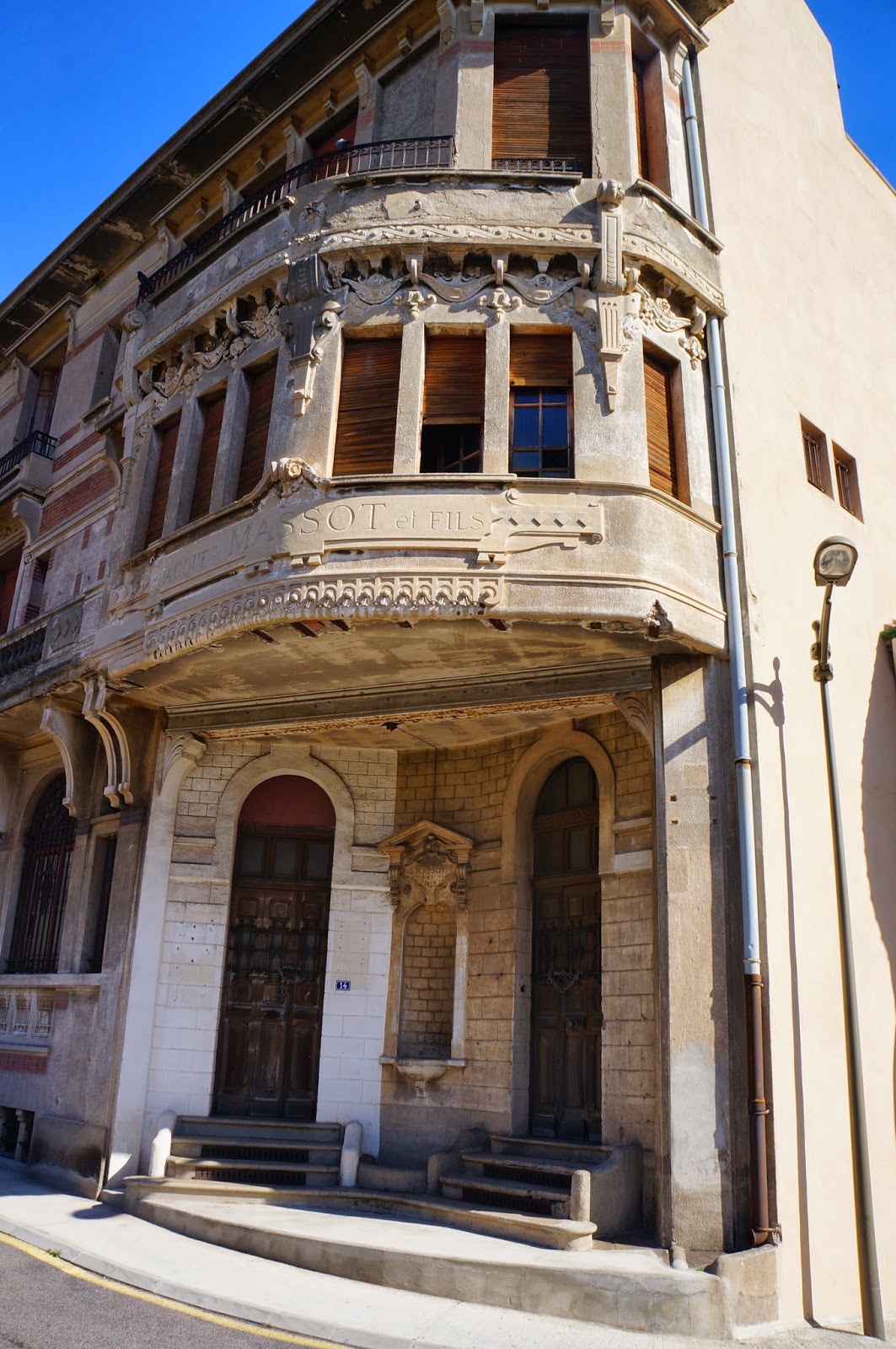
Cerbere, Forgotten City

One of the most memorable places I visited in France was the town of Cerbere, which is kind of like a French Detroit in so far as it was once a booming destination, the epi centre of a vibrant economy, that is now a forgotten town whose population has gradually dwindled and whose once lavish relics stand      vacant and decrepit, though some still quite majestic in a haunting sort of way.

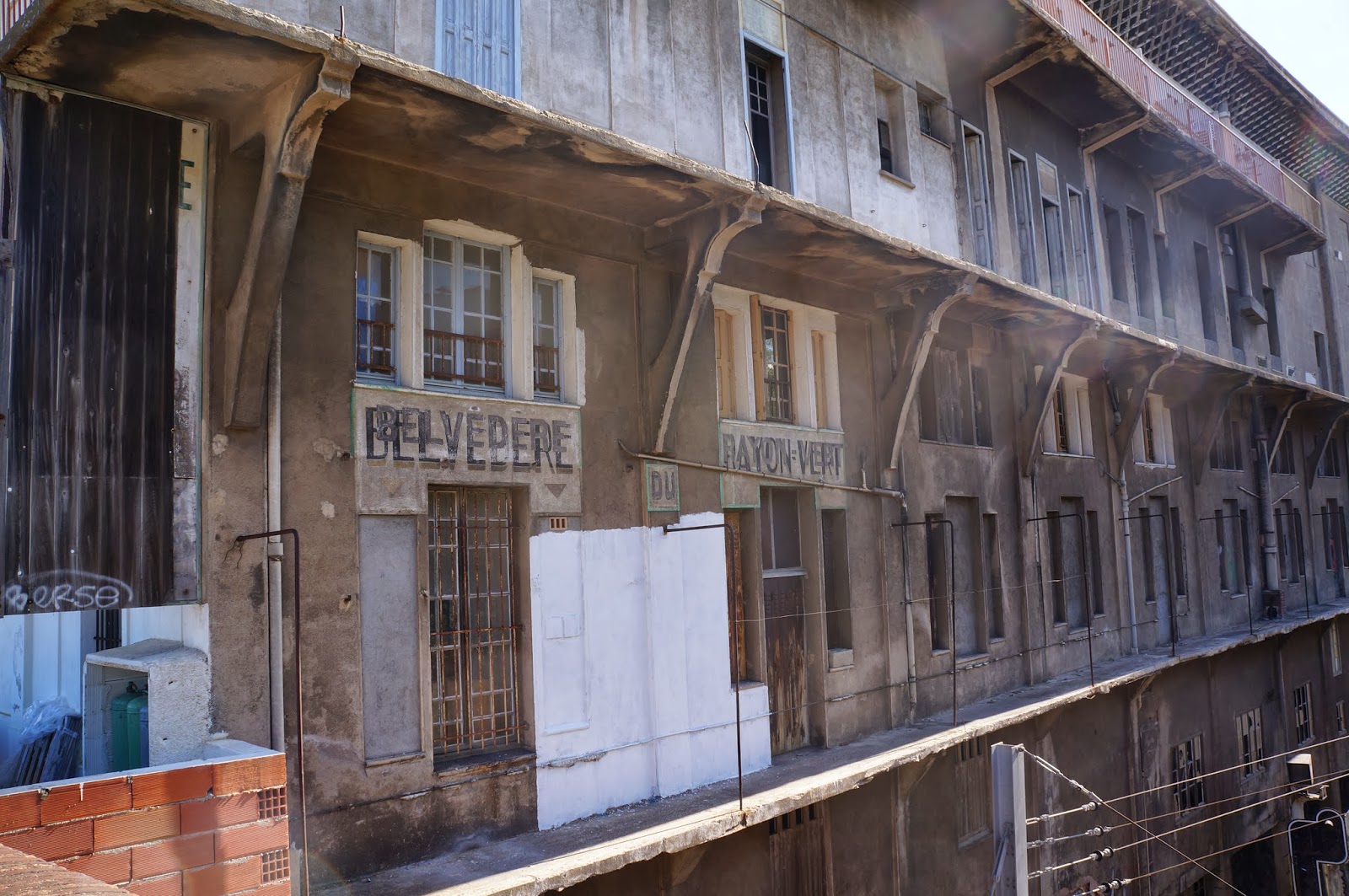
Before the European union erased borders, the mechanization of the railway system, and the development of vast automobile and air plane travel, Cerbere was a place of trade and leisure as it is the last French town before Spain, which is only 4 kilometers away. The train is what built Cerbere. Because the Spanish rail system was different than the french, imported and exported goods had to be moved through manually, which created many jobs for people on both sides of the border. Since it took a while for people to get through the paperwork to cross into Spain, Cerbere became a tourism Mecca as developers saw the opportunity to make the waits appealing. Most notably the ship-shaped Art Deco palace (now a faded beauty), le Belevere Du Rayon Vert Hotel, became a destination in its own right with its high class rooms, roof top tennis court, impressive theatre, and luxurious banquet halls overlooking the Mediterranean sea that appealed to the 1930s glitterati. Josephine Baker even performed there. But now the place is empty despite the owner's painstaking efforts to foster a revival,  save for a few legend seeking tourists (like me) who come for a guided tour or to rent a "revamped" apartment there for a weekend. 

Cerbere feels kind of like a ghost town. The mechanized voice of the National Train Corporation (SNCF) still reverberates through the entire town every hour announcing the incoming trains, but now this is just a pit stop for most travellers. Though if you hang out long enough you can witness some beautiful snippets of Cerbere's present life, for example I listened to a group of old timers sitting on a bench in small renovated concrete covered park and was struck by the beauty of their sing song accent, an interesting mix of Spanish and french, which made more of an impact on me than anything else I saw on this incredible field trip to "la ville au bout du monde."*

*city at the end of the earth, as it's sometimes also called. 


Sunday, 7 July 2013

Blindly Lead Me

The other day my boss called me into his office and I just knew it was going to be one of those conversations where I would have steam coming out of my ears.Apparently the "health and safety committee" (one of many committees) of our organization determined that serving expired food to our clients is a health hazard. Really? That never crossed my mind day in day out when I personally hand out two-day old ham sandwiches, five day old yogurt, stale bread and dubious looking hamburger to those we are meant to "help."  So the powers that be have noticed a problem and have given the orders that all food that is past due shall be thrown out.

OK so it seems we are on the same page, at least on the surface, though the inconsistencies of the charity food system are hardly a new discovery. One of the biggest issues or "hazards" from my perspective is that the organization refuses to turn down anything out of fear of offending donors. This means that a larger percentage of what we get is crap, which we spend money (and resources) on sorting and disposing of in the name of PR. This goes for food too, though often we are forced to salvage and serve what we can--without expired food we would not have a meal program; an obscene catch 22 that we are forced to be complicit with, allowing individuals and corporations the opportunity to feel good by dumping garbage (literally sometimes) or non-perishables (same thing) with ignorance and good intention (though you know what they say about those.)

I once got in trouble for saying that I rather have the clients starve to death than to serve them pastries first thing in the morning. Is this not the same attitude on a broader level, served without indignation?

Those at the top have of this inevitably hierarchized system have more power than I do, yet the buck is passed off silently.  Alas the organization is not really getting with the times, they are only repackaging the inadequacy of the system as a shortcoming front line workers need to fix. By framing this issue as a "health and safety" concern limited to the workers of the organization, management is grossly simplifying a complex, systemic issue thereby precluding any meaningful solution to the food situation.

 The conversation really should go beyond whether food is expired or not in an immediate sense. What we should really be speaking about at an organizational level is food insecurity: the degree to which a sizable proportion of the population of this supposedly affluent nation do not have the means with which to access adequate food through acceptable--aka non-soup kitchen--channels. These are the people we are meant to assist. Food insecurity (malnourishment, not simplistically defined hunger) is part of the same issue as housing insecurity, which is the niche the organization I work for ostensibly concerns itself with most. These issues should not be considered separately, they are part and parcel and linked to the economy--the same economy that allows for the overproduction of goods which leads to waste (that gets tossed into the charitable landfill.) As long as the organization refuses to systematically acknowledge and verbalize the short comings of the system we work within we will continue to buy into and perpetuate the worst aspects of charity. Without meaningfully reflecting and dialoguing about our position in the charitable "economy" we will keep simplifying social justice issues as logistical concerns and never move beyond the band aid.

The layers and layers of management aren't coming up with a solution, such as a food policy, an interim donor education program,  a budget for an adequate food program (we all know that it is the more controversial, and infinitely sexier aspects of the "harm reduction" continuum that foster cash flow these days--yet we refuse to talk about this.) As a result it is up to the lowliest cogs in the machine to "innovate" with their few resources and cultural capital.So who looks at the bigger picture?

Wednesday, 12 June 2013

Community Kitchen: Feast of Falafel

This week, I did my first Community Kitchen in over a month. A hiatus was nice as it gave other staff a chance to run the program and to expose the participants to different styles and flavours--in other words, it gave these gents (and the occasional lady) a break from cilantro and kale. On my end it was nice to replenish a bit.  Community kitchens can be a bit taxing, and there are few things worse than an exhausted and therefore uninspired facilitator ( my long stint taking university courses delivered by lack luster profs taught me at least that).


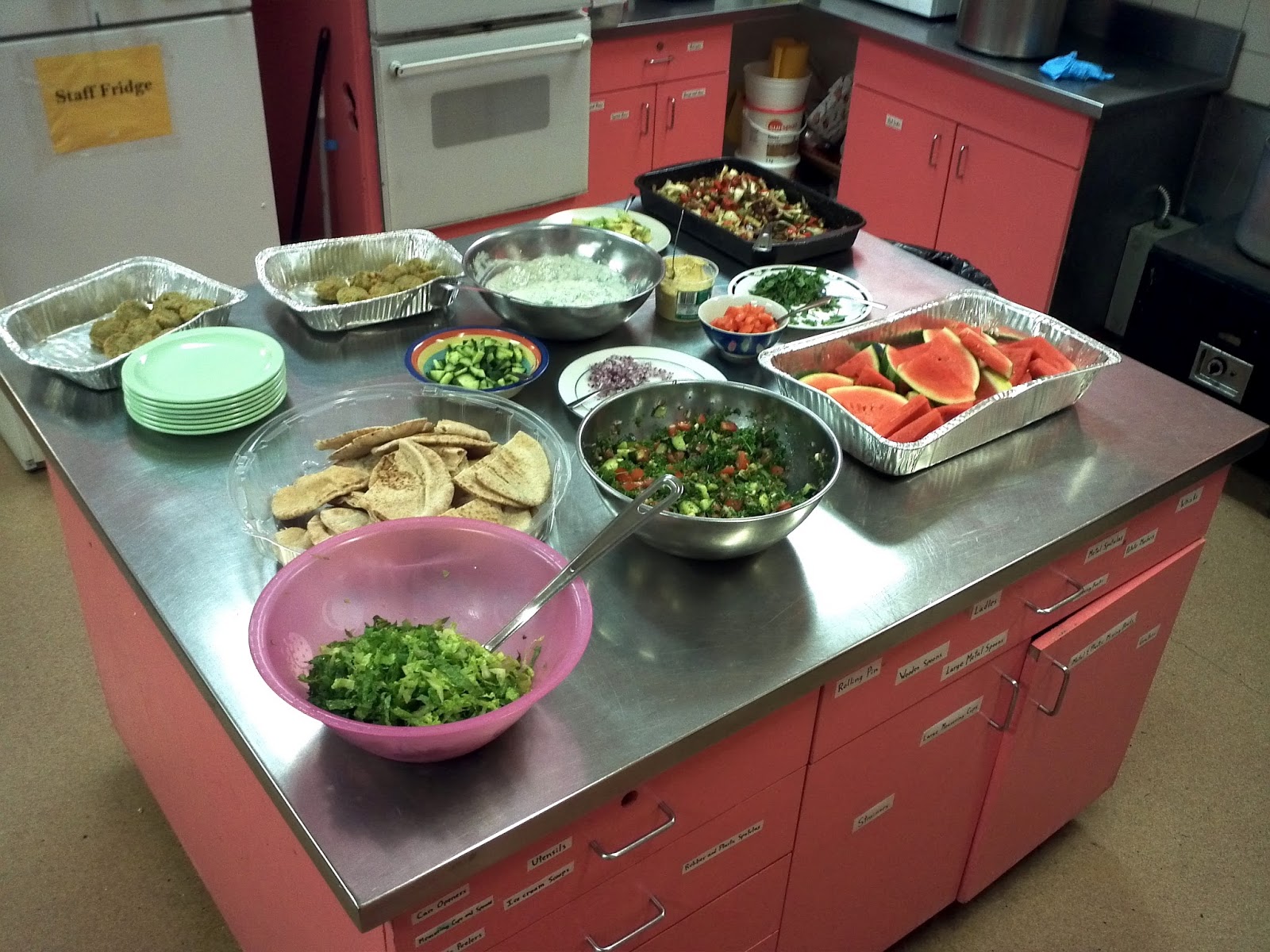
Our humble spread offsetting the institutional space a bit...
Some time away really helped me realize how much I love this program. In honour of the CK and all the people who have been regulars for almost two years we made an awesome falafel feast! This spread was such a hit that nobody asked for ice cream (one of my coworkers got them used to the good--and not so healthy--stuff in my absence.) And nobody asked "wheres the meat?" or even the cheese! Yes this meal is basically vegan (save for some homemade tzaziki,which can be replaced with tahini, hot sauce, baba ghanouj, hummus or anything at all) and nobody noticed! This version of the falafel is baked so it is also healthier in that respect. We ate ours in a whole wheat pita, but the falafel patties could easily be wrapped in collard or lettuce leaves, or served on top of a salad....I chose the bread option mainly because I didn't want to push it too much with my loyal crew.

Falafel: Makes 12 (cut recipe in half if serving a smaller group, or freeze patties)

2 cans or 1 cup of dry garbanzo beans (with 1/2 cup of water reserved)
1/2 cup of flour of your choice (i used chickpea)
1 tablespoon of baking powder
5 cloves of garlic
a few mint leaves (optional)
1/2 of a cup parsley
1 teaspoon of cumin
dash of cayenne
salt and pepper

Directions:

Turn over on to 350 degrees. Throw everything in a food processor or pound everything in a bowl with the back of a wooden spoon (if moisture is needed add a bit of water or reserved chickpea water.) Roll into ping pong-sized balls. Place balls on a baking sheet greased with coconut oil. Bake for 15-20 minutes (rotate mid-way) and put on broil for the last 5 minutes to achieve crispiness.

Tzaziki-ish:

2 cup Greek yogurt
1 small cucumber-shredded
2 tablespoons lemon juice
1 teaspoon cumin
1/2 teaspoon cayenne
1 clove of garlic-minced
1/4 cup of dill-minced
1 small shallot sliced
salt and pepper to taste

Directions:

Throw everything in a bowl and take out your aggressions with your spoon by making circular gestures until everything is combined.

Sandwich assembly:

In wrap of your choice place shredded lettuce or greens of your choice, diced cucumbers, tomatoes and minced parsley. Top with two falafel balls and sauce. Bon appetit!

We also made a killer tabbouleh (I'll be sure to post the recipe soon), and some simple yet very tasty roasted vegetables...

Sunday, 19 May 2013

Going Nuts Over DIY Almond Milk (gross pun, awesome recipe)

Most of us know the evils of dairy: the inhumane treatment of cows, the loads of toxic substances they are given to raise their [re] productive value, the fact that milk products actually strip our bones of calcium, and that cow dairy is not    easy to digest (morally and physically.) Many, myself included, avoid dairy (though I could never say a decisive adios to cheese) or opt for dairy free milks. But dairy alternatives aren't all that desirable either. Unfermented soy is increasingly known to be a problematic substance causing hormonal imbalances and certain cancers. And I would much rather eat raw organic cheese from a humanely (relatively speaking) raised cow (or a goat, preferably) than ingest the uber-processed, vegan alternative.

Rarely criticized is commercial almond milk, which has never sat well with me despite it often being recommended as the "healthiest" alternative to dairy.  Take one quick glance at the ingredient list and you can see why! Cane sugar (table sugar's cousin in disguise)? Carrageenan (allegedly a cancer causing compound derived from seaweeds)? Synthetic vitamins? Most commercial brands are pumped with these and a whole whack load of other additives that don't sound like anything I want to put in my body. Also, not all nuts are created equal. I doubt that the companies that put out these products go the extra route of sourcing the best almonds and soaking these to avoid rancidity and toxicity. I also doubt the actual quantity of almonds used. There are no exact ratios printed on the typical cartons we find in the shop, though the low fiber content on most labels is a good indication. 


Thankfully it is super easy to make pure, delicious, healthy almond milk at home. Intrigued for a while by DIY nut milk, it is my most recent trip to Café Bliss in Victoria BC (which I reviewed a few posts ago) that finally compelled me to hit "blend," because I am addicted to their Matcha Latte and live too far to have it everyday. I know that what elevates their drinks to godly levels of awesomeness is that they make their own nut milks. Well now I do too, and so can you!

Almond Milk Recipe (or any nut recipe if you want to mix it up!): 
1 cup of raw organic almonds soaked overnight
3 cups of water
1 spoon full of raw honey or a few dates (optional) for sweetness
1/2 spoon of coconut oil (optional) for added richness

Directions: 
Drain soaked almonds and rinse well. Place soaked almonds and water in a blender or food processor and blend on high. Once mixture is creamy and milky pass through a cheese cloth, fine mesh strainer, or a nut milk bag. Once strained keep the milk as is in a jar (that's how I like it, au naturel) or blend once more with sweetener of your choice and/or coconut oil.

Yields: 
This will yield about four cups of product that will stay fresh for about 4 days. It is not the cheapest addiction as quality almonds are a bit expensive, but will work out to about 10-15 dollars a month for someone like me who uses almond milk only in my morning, water-based matchas. For a cheaper option consider making milk out of oat groats, which is also delicious, healthy, just as easy (same recipe!) and insanely cheap!

PS. Nut bags are in my opinion an awesome investment as they are made of organic and natural fibres, are virtually indestructible, will also generate more product for you, and can be used to make sprouts. The one I use is made locally in Vancouver out of organic hemp and can be ordered online or, if you are lucky to live in Van, at Homesteaders Emporium, a great shop for everything DIY and food related.

Check out this great nut sack (sorry, bad joke) here: 

http://www.grassrootgreens.ca/nut-milk---sprouting-bags.php

PPS. Don't throw out the almond meal! It is super nutritious and can be frozen and used for pancakes, cookies, cakes, as a topping, or (once dehydrated or roasted) as an ingredient in granola and a whack load of other recipes you can come up with...


Wednesday, 10 April 2013

Community Kitchen: Detox-Slaw and Black Bean Cocoa Chile

As I've mentioned a few times on this blog, I run a community kitchen at my work each week. The food we make is so awesome (and healthy!) that I've decided it's too much
of a shame not to share the recipes here, so I will try to consistently do so from now on.

Since I spent the weekend in Victoria eating decadent foods at some of the many terrific eateries there (that I will write about very soon), I felt, perhaps more so than usual, like making healthy and detoxifying foods for this week's CK.

So we threw together an awesome organic "slaw" consisting of a bevy of ingredients that detoxify the body and facilitate digestion. No mayo here! A simple, tasty combination of shredded beets, carrots, julienned apple and fennel, tossed with a dressing of alkalizing apple-cider vinegar, fresh squeezed OJ, and olive oil. Of course it doesn't hurt to throw in some immune boosting (and tasty) spices like  cayenne, ginger, cinnamon and turmeric, along with a ton of fresh garlic. Abundant fresh parsley tied it all together and added even more colour and antioxidant punch to the mix!

I wanted something tasty and grounding as well. Enter my dad's black bean chili. This is the one vegetarian dish in his repertoire so he makes it for me each time I visit, which might explain why my visits are becoming more frequent as of late ;) This dish consists of a combination of refreshing cilantro, crunchy red peppers and sweet black beans and is deceivingly simple as it harbours complex flavours that will rock your taste buds like nobody's business. On top of the cayenne, chili powder and a generous amount of of garlic,  I added cocoa to mine for extra depth of flavour (feel free to switch with raw cacao at the end for a nutritional boost), as well as smoked paprika for a bit of kick--though the traditional cumin alone is more than decent.

Black beans are magic as they naturally regulate blood sugar levels, making them appropriate for my diabetic participants ( and for a mega sweet-tooth like yours truly!) We served the chili on a bed of red rice, a nutty flavoured, whole grain that is as delicious as it is grounding. We topped the whole affair with shredded organic sharp cheddar, green onion and a dollop of natural Balkan yogurt.

This simple but explosive meal had even the most stubbornly carnivorous CK participant reaching for thirds.

Proportions for 8 people:

Detox Slaw: Ready in 15 minutes including prep (with a food processor)


In a large Bowl Combine:

3 large Beets- shredded
3 medium carrots-shredded
1 medium fennel bulb-julienned
2 apples of your choice-julienned
1 bunch of parsley -chopped
3 cloves of garlic-minced
Salt and pepper to taste
1 chunk of ginger root minced
Handful of unsulfured raisins (optional)
Handful of hemp or pumpkin seeds (optional)

In a separate Bowl whisk:

3 large oranges-juiced
1/4 cup of Olive Oil
1/4 cup of Apple Cider Vinegar
1 and 1/2 teaspoon of cinnamon
1 teaspoon of Cayenne
1 teaspoon of turmeric

Toss everything together and voila!

Black Bean Cocoa Chile: ready in half and hour including prep/longer if you have time!

1 large sweet onion-diced
4 standard-sized cans of black beans-drained and rinsed (or use dry)
4 medium red peppers-diced
2 jars of organic strained tomatoes
5-6 cloves of garlic-minced
1/2 bunch of cilantro-finely chopped with some stems
1 lime-juiced
1 tablespoon of cocoa-levelled
Cayenne-to your taste
Chile Pepper-to your taste
1 jalapeno- sliced (optional)
Salt and pepper to taste
1 dash of coconut oil (or olive)

Directions:

In a pot, brown your onions in the coconut oil. Once these become translucent, add your peppers until they are softened. Add the strained tomatoes and all the spices except for the cocoa. Let simmer for 10 minutes or more to develop flavours, then add beans and 2/3rds of the cilantro as well as the garlic and jalapeno. Let simmer for a while remaining mindful of not letting the beans soften too much (dry will remain toothsome for much longer). Turn element off and stir in cocoa, the  rest of the cilantro, along with the lime juice. Let sit for 5 minutes and serve!


Sunday, 7 April 2013

A Load of S--T!

If you read my prior two posts you  will see that I have been on an anti-meal replacement roll this last week. While I am getting a little tired of the topic today (though I plan on pursuing this cause vehemently even if I am foaming at the mouth),  this photo, provided to me by the awesome outreach worker who schlepped the shit around twice, is too absurd not to share...It also debunks one of the top justifications for maintaining this "industry standard:" Cost Effectiveness.


This is what 1200 dollars worth of Ensure looks like--thankfully this flat was on its way back to the Superstore warehouse and will not be given out to street-entrenched, HIV positive clients. The entire non-profit/medical industry in the DTES (and probably beyond) relies on this product as a "cheap" and convenient solution to the nutritional vulnerability of the populations we are meant to assist.

Clearly this is not an inexpensive product. It is expensive in terms of the physical repercussions of ingesting a synthetic and chemical cocktail, but also in terms of $$ amounts!

1200$ can buy a second hand fridge and enough ingredients to make and serve whole, nutritional smoothies several mornings a week, or to purchase less involved options such as bananas, hard boiled eggs, even natural energy bars (i.e Larabar).

Convenience a euphemism for lazy? In some cases yes, but  at best the industry is uninformed. My manager spoke to a whole class of future social service providers who were shocked that Ensure is not a healthy choice.

And if people would like to counter my stance, I urge them to do research on the first ingredients listed on the label and to demonstrate to me how these could benefit people in precarious health (or any one at all.)

Water, Corn Syrup, Maltodextrin Corn, Sodium And Calcium Caseinates, Sugar Sucrose, Canola Oil, Corn Oil, High-Oleic Safflower Oil, Soy Protein Isolate, Soy Lecithin, Natural And Artificial Flavors, Carrageenan, FD&C Red No. 3, FD&C Yellow No. 6, FD&C Blue No. 1.


Friday, 5 April 2013

Rest Ensured! (An update)


Kitchen beats the Lab!
A small victory! After a semi-arduous process that involved a screaming match with my manager, him mulling over my scathing (semi-psychotic) critiques, and the help of Peter, the practicum student who just happened to be a health nut summoned to research the facts (perhaps more convincing than my impassioned, militant, back alley uproar), the 1200 dollars of chemical sludge known as Ensure is on its way back to the Superstore!

I am elated not just because of the tangible benefit to our clients, but because on a broader level this success demonstrates that fighting for your values and for what you believe is the ethical choice can sometimes pay off.

The battle continues though. Ensure is after all the industry staple (along with Glucerma by the same company made special for diabetics). I found out from Peter that our organization has a whole warehouse full of that crap!

But the conversation has started. I plan to bludgeon management with as much info as I can possibly package in a readable format and my own boss is on board! While I know that  "the revolution cannot be funded," (Great book, check it out, especially if you are working in the social services field: http://www.incite-national.org/index.php?s=89), meaningful change can (albeit painstakingly at times) happen from within the NONPROFITINDUSTRIAL compound.

I now have 1200 dollars to spend on a new (non-patronizing, victim blaming, tasty, and natural, I'm thinking) nutritional program for people with HIV.

The wheels in my mind are a spinnin' spinnin' spinning!

My number 1 principle: don't serve anything you wouldn't eat

Tuesday, 2 April 2013

The Danger of Unprocessed Food

Today, my commitment to unprocessed, natural foods almost caused me serious harm. How? I nearly got hit by a car on my bicycle commute home from work! Why? Because I was so pissed off I wasn't paying attention. 

Moments before the end of my shift my manager pulled me and by coworker Jess aside to tell us that he had received an extra 1200 bucks from another site's HIV program. This got me momentarily excited as all the possibilities for the meal program flashed by in my imagination. I had visions of daily green smoothies, a weekly supply of eggs, a reserve of various whole grains to replace the bread and margarine we are trying to phase out, or at the very least caseloads of organic butter to replace that deadly margarine! 

But this excitement was very short lived. My manager decided to sink that money into caseloads of Ensure meal replacements since he only had an afternoon to figure it out before the long weekend (and the end of the fiscal year when all "surplus" money has to be spent so as not to piss off our funders). 

I am absolutely appalled and heartbroken. Ensure is one of the worst things we could serve our clients, particularly those with HIV whom this extra cash is meant to assist. These "meal replacement" drinks are ubiquitous in the DTES as they are routinely given out by agencies, doctors, and welfare workers here to those most sick and malnourished. Ensure interestingly has high resale value on the street, most likely because when one is sick and/or high it is hard to stomach much of anything at all and perhaps since Ensure is handed out by "experts," it is actually thought of as beneficial to dwindling health. Everyone needs a bit of ideology to feel better, even more so when your head is in the gutter. But in my opinion, these drinks are worse than a band aid solution, they actually make existing issues worse. 

1. Ensure is filled with chemicals, toxic substances and just a few synthetic nutrients, all of which push already weakened bodies to work even harder to try to assimilate the harmful substances that make up the drink's ingredient list. The combination of sugar, corn syrup, soy oil, corn oil, soy lecithin (these are just the first of over 40 unpronounceable) hardly constitutes a therapeutic substance. We may as well hand out  a few vitamins along with a bottle of coke!

2. As long as professionals hand out this crap nothing will get meaningfully better. Ensure is perhaps cheaper than a whole food alternative (and I would argue that this isn't necessarily the case) and more convenient (are we really that uncreative and lazy?), but these benefits far out weight the cost, and our justifications (i.e it's better than nothing--not true) only contribute to the false impression that at least something is being done. In the case of my agency it's even more blasphemous since we had some money (unadulterated by the industry discounts or stipulations that most likely also fuel Ensure's strong presence in the DTES) to spend on an alternative and there are people (me and jess!) who would take the time to maximize that 1200 dollars and create something healthful that would actually address our clients' nutritional needs.  

So yeah I am really pissed. 


Saturday, 23 February 2013

Free (ing) social theory!

Monday I realized just how hungry I've been for intellectual stimulation and, even better, that I am not alone! Thanks to the Vancouver Institute For Social Research, a free series of professor-led talks that aims to free critical theory from the confines of the University,  I am now able to flex my brain once a week with about one hundred wool clad, designer framed theory nerds of all ages (who made up the majority of those present) at the Or gallery!

The list of speakers is awesome including two of my own heroes, Steven Taubeneck (who I took existentialism and post-war German lit with and who made an impression on me by forcing the most entitled students-as-consumers tell him what they thought of the state of the world) and Thomas Kemple (who I took two theory courses with, who encouraged me to write unorthodox papers and who got my ass into grad school.) 

This week's speaker, Clint Burnham, presented a genealogy of the "unconscious" from Freud, to Lacan, Benjamin, Jameson, Krauss and Zizek and examined the degree to which the Internet functions as an extension of this tradition. This was in many ways a "graduate class" in so far as the levels of abstraction reached by both the speaker (and the thinkers he presented) require some degree of higher education to comprehend (either formal or informal yet library based), which demonstrates the degree to which this really is a "para-university" and therefore not completely inclusive. But the choice of conceptual device to expand on these thinkers made the talk somewhat more accessible, and quite brilliant. My head kind of hurt by the end of it but I thoroughly enjoyed every minute of the seminar and felt strangely energized the following day! The evening also restored some of my hope in the world to tell you the truth, due to the number of people who actually voluntarily showed up reminding me, much like the Anti-Olympic and Occupy movements did,  that Vancouver has a place for political discourse.

These talks happen every Monday from 7-9 (though show up early because seats fill up) until April 1st (and hopefully thereafter, as this is the pilot phase of the project). Readings are accessible online and free of charge on this website, which will also tell you a bit more about the varied topics that will be discussed: 


And check out the Or Gallery website to find out more about this and other events: